Showing posts with label palm product. Show all posts
Showing posts with label palm product. Show all posts
Apr 30, 2013
Apr 22, 2013
Production, Transportation, Refining and Distribution of Palm Oil

What is actually involved in bring it to supermarkets and homes?
It can be purchased in bottles and is popular in countries that have
embraced it as a cooking oil. Some of us might not be aware that it can
also be present in many of the products that we enjoy eating. Even many
of the popular scented soap brands use Palm Oil as a major ingredient in
the manufacturing process. Palm is plentiful and a major source of
vegetable and cooking oil. If you happen to live in countries like
Malaysia and Indonesia, you cannot help but notice that certain parts of
the countryside are populated with millions of palm trees. Palm Oil has
become a major commodity on the world market and it is a growing
industry and can even be used to produce biofuel.
First of all the
Palm Trees have to be picked. It is actually the seeds that contain the
oil. These seeds are then crushed in a Mill and separated by process
systems to produce something called CPO (crude palm oil).
Once the
mill is satisfied with the quality of the oil it can be transported to
refineries. If it is being transported by land it will most likely be
kept in large containers on trucks. These trucks will deliver the
product to refineries who will process it even further into purer oil.
When palm oil is being delivered to refineries it is either sampled
manually or goes through electronic "palm oil quality monitors"
CPO
Refineries are always watching the price of the commodity which is also
traded on the stock market so timing can be important.
Finally,
these refined products are sold to agents and distributors in smaller
quantities who then use the palm oil as a base product or a component of
goods that will be found on supermarket shelves and used in homes.
Palm
competes with other types of oil such as Canola and Sunflower Oil. The
distribution of palm oil and palm oil related products will depend
mostly on the preferences of end manufacturers of products which also
can be influenced by consumer preferences. Palm for cooking is highly
respected in countries like Thailand, Malaysia and Indonesia where it is
commonly found in restaurant food. There are many benefits to using
Palm Oil in these locations but one of the major benefits is that it
will be competitively priced compared to other types of vegetable oil
which might be costlier to import.

Apr 19, 2013
Review - The Palm Oil Miracle
The Palm Oil Miracle, Dr. Bruce Fife, 2007, ISBN 9780941599658
This
book is all about palm oil, a seemingly "miracle" vegetable oil that
has been used for thousands of years, and is currently being used around
the world. But it is generally unknown here in America.
The
reason for America's unfamiliarity with palm oil is that, for the last
30 years, Americans have been subjected to a huge amount of corporate
propaganda (what else is new?). The culprit is the domestic vegetable
oil industry. They have convinced the average citizen that tropical
oils, which are high in saturated fat, are a leading cause of high
cholesterol and heart disease. Supposedly, poly- and monounsaturated
fats are the way to go. If that's true, why are the rates of heart
disease much higher in America than in the rest of the world?

Palm oil is used
in cooking, baking and deep frying, and can be used in place of
margarine or vegetable oil. It can be used as a dietary supplement, and
is non-toxic even in large amounts. It is even a natural anti-aging and
anti-wrinkle moisturizing skin cream. The book also includes recipes
that use the oil, to cook and see for yourself.
Here is a
fascinating book that is full of useful information for anyone. If the
medical profession can only suggest a long and expensive course of
treatment for whatever ails you, consider reading this book. What have
you got to lose?
Paul Lappen is a freelance book reviewer whose website,
[http://www.deadtreesreview.com], has over 800 reviews on all subjects,
with an emphasis on small press books.
Apr 18, 2013
Vitamin E - Did You Know Palm Oil Is Packed With This Nutritional Supplement?
Vitamin E: The briefest of introduction!
A combination of 8
related molecules known as tocopherols constitute the Vitamin E. The
most biologically active amongst them are Alpha-Tocoperols and they are
responsible for most of the benefits the body receives from the
absorption of this particular nutritional supplement It is a stable
fat-soluble vitamin, which means that our body can easily break down its
potency and nutrients. The daily allowance for Vitamin E, as
recommended by the US FDA is measured at 8 to 10 milligrams (15 IU) per
day. There are a number of experts however who recommend a much large
daily dosage such as Dr. William Shute. (In his widely acclaimed Book of
Vitamins, he suggests a daily dose of at least 800 (up to 1600) IU.)
This high dosage is thought to play a beneficial part in the prevention
of arterial degeneration, which is a devastating vascular damage caused
by diabetes.

Vitamin E: How is it beneficial. (If you must know something, then let it be the following!)
According
to a research conducted by the folks at Yale University, the unwelcome
physical decline that goes hand in hand with aging can be positively
affected by a daily intake of this substance. This doesn't mean old
folks who were finding difficult to get out of bed will all of sudden be
able to leap out in one graceful jump but research did show a gradual
rebuilding of vitality which transferred over to a better overall
health.
Vitamin E and Diabetics:
In a Swedish Study, Vitamin
E therapy as a treatment for diabetes was put forward and supported.
The findings includes suggestions such as an advisable daily intake dose
of 200 IU of vitamin E over the course of two weeks. The study suggests
that Vitamin E helps decrease the insulin requirements of Diabetic
patients.
Breast Cancer and Vitamin E: In a society
ravaged with an alarming number of women diagnosed with Breast Cancer,
vitamin E, taken in proper form appears to be a considered method of
reducing the risk of this illness. A number of studies have demonstrated
that the risk of contracting Breast Cancer double for women with low
levels of vitamin E when compared with those who take the recommended
minimum requirements. These studies indicate that some Vitamin E
components found in food may be the reason for the reduction in Cancer
of the Breast incidence .
There are two classes of Vitamin E:
There are two classes of Vitamin E:
- Tocopherol, the form usually found in supplements
- Tocotrienol, found in food. For example palm oil .
Foods rich in Vitamin E are:
- Oils: vegetable oils such as palm oil, sunflower, corn, soybean, and olive oil.
- Good sources of vitamin e are egg yolk, margarine, Parmesan,cheddar,chickpeas, soya beans, avocados, olives, carrots, parsnips, red peppers, tomatoes, sweet potatoes, sweet corn, and watercress.
- Other sources can be found in fish, goats milk, whole grains,wheat or cereal germ, oatmeal, whole grain products peanut butter, fruits, vegetables, milk and all whole raw or sprouted seeds. Because of the hectic life we seemingly lead in this modern world
Did you know?Vitamin E supplements and all Dietary supplements are measured in international units (IU) .
Did you also know
that the word 'Vitamin" is the combination of two words proposed by
Dr. Cacimir Fun who in 1911 talked about "Vita Amine" when referring to a
new food substance used in the cure of beri-beri.
Several
decades later, the final "e" was dropped and a new word was created:
Vitamin! Vitamins as micro-nutrients were actually discovered earlier
(1887) when Dr.Eijkman who was studying a disease in Indonesia called
beriberi realized that fowl who were fed with polished rice developed
the disease whereas those fed on crudely milled rice did not.
Nutrition has always been the best source for our supplemental needs. Vitamin E
is not different and can be found in all the food sources mentioned
above. If you choose to take Vitamin E in supplemental form, our best
advise would be Organic Vitamins.
Apr 17, 2013
Palm Vitamin E Tocotrienols Benefits

Vitamin E occurs in substantial amounts in oils and fats. Generally, the higher the polyunsaturated fatty acid content of oil, the higher the vitamin E requirement. An average ratio of vitamin E to polyunsaturated fatty acids of about 0.6 mg/g is highly desirable.
Vitamin E mostly occurs as alpha, gamma, and delta tocopherol. The composition of vitamin E in palm oil is, however, quite different. Only about 30% of its composition is tocopherol, whereas the rest occur as tocotrienols (alpha, gamma and delta) which are again different isometric forms of vitamin E.
Apart from palm oil, rice bran, wheat germ and barley germ oils are good sources of the tocotrienols.
Benefits of Vitamin E Palm Tocotrienols
Tocotrienols have a chemical structure that is slightly different from the tocopherols.
Research has already determined that this structural difference, while allow it to perform all the classic functions of vitamin E, additionally confers important biological and physiological properties that are not noticeable in tocopherols.
Good manufacturing practice ensures that a substantial amount of palm vitamin E is retained in palm olein, commonly used as cooking oil in our Asian cooking. When crude palm oil is refined, a portion of its vitamin E is concentrated as a by-product, called palm fatty acid distillate (PFAD).
Now, innovative technologies allow the recovery of this palm vitamin E as a concentrate that contains about 30% tocopherols and 70% tocotrienols. Palm vitamin E is now commercially available in Malaysia and other regions.
Article Source: http://EzineArticles.com/4982433
Apr 15, 2013
Apr 8, 2013
Palm Kernel Oil - A Good Household Remedy for Children's Ailments
From the recent trend of medicinal research, which has to do with
plants and their extract, and the results obtained and published so
far, one can say that nature (God of creation) has bestowed on man all
he has need of. Palm kernel oil for instance, is used in African
(Nigeria) medicine to treat a number of ailments that affect infants-
such as convulsion. Every little plant we see around us is likely to
contain one or more substance (components) that is a likely cure one or
more ailments. Although research has shown some of them to be poisonous.
For instance, there is a claim by the Yoruba's in Nigeria- West Africa,
that the roots of maize can be used as a poison.

PKO can
be used to treat ailments like cold, catarrh, cough, convulsion, skin
infection and stomach upset among others disorders that affect children
(as well as adults).
• For catarrh, cold and convulsion,
particularly in children; simply rub the oil all over the child's body
consistently- say thrice a day for about 7 days and be sure the ailment
will be gone in about 10 days. In the course of doing this evidence
abound that the skin of such child will be prevented from being infected
by some skin pathogens.
• For cough and stomach upset/ disorder,
taking a 5ml twice daily orally will suppress the cough and stomach
disorder. In addition to this is the fact that it serves has a
purgative, this may not be unconnected with the oily nature of the
extract although the phytochemical constituents may also be responsible
for this effect.
• Lastly, though like a superstitious believe is
the claim of its use in some parts of Akwa-Ibom in Nigeria, as a
repeller of witches. The claim is that when burned the aroma of the oil
drives away witches.
In conclusion, the traditionally extracted
Palm Kernel Oil is of great medicinal value not only for children but
also for adults, and it's healing potential for the ailments mentioned
earlier is an indication of its antimicrobial properties for the
microbes causing some of those ailments.
Mar 19, 2013
Exports of Palm Oil & Palm Kernel Oil
Palm oil is the most traded oil in the world. In 2011, its exports
reached almost 39.04 million tonnes of which Malaysia’s share was 46%.
To add value to crude palm oil and make it ready for human consumption,
Malaysian manufacturers have installed the most extensive and efficient
refining and fractionation facilities. This had been most successful
during the years of 1974 to 1999, when the exports of processed palm oil
grew from 0.9 to 8.9 million tonnes. In 2011, Malaysia’s export of palm
oil rose to 17.99 million tonnes, after reaching a high of 16.66
million tonnes in 2010. Similar trend in export of palm kernel oil was
seen in the same period, with the volume reaching 1.17 million tonnes in
2011.

Mar 5, 2013
Palm Oil Biofuel to Curb Oversupply
by Linda Yulisman, The Jakarta Post | Headlines | Thu, January 10 2013, 11:45 AM

Indonesia, the world’s biggest palm oil producer, is mulling a move to produce biofuel to manage abundant local supplies.
Deputy Trade Minister Bayu Krisnamurthi said on Wednesday that the move would become a “fundamental solution” to curb an oversupply of the commodity in the overseas market that, has in part, contributed to falling international prices.
“We are trying to convince various stakeholders that if we can convert up to 3 million tons of palm oil into biodiesel, it will be a game changer in the market,” he said.
The government has allocated a subsidy of Rp 3,000 (31 US cents) per liter for biodiesel, with a total allocation of 900,000 kiloliters. It is hoped that the subsidy will promote the use of renewable energy sources and cut dependence on fossil fuels.
The endorsement of biofuel, either biodiesel or bioethanol, started in 2008 following increases in the price of fuel. The government issued a ministerial decree that required the blend of all oil-based fuels with biofuels.
However, domestic biofuel consumption never reached the designated annual targets. In 2010 consumption only stood at 223,041 kiloliters, far lower than the target of 1.73 million.
The domestic industry, on the other hand, has seen robust overseas demand for biofuel with exports last year topping 1.4 million tons, particularly to the European Union (EU), where the member countries are bracing to apply a new renewable energy directive. Bayu said that the local absorption of palm oil for bio diesel would also create healthy competition with its top rival, Malaysia, the second biggest palm oil producer.
Indonesia introduced a new tax policy in late 2011 that cut export tax on refined palm oil products from 25 percent to 10 percent to encourage local producers to export value-added products.
The new structure complements a progressive tax on the export of crude palm oil (CPO) that begins when the commodity’s price is more than $750 per ton. Exporters are required to pay an export tax of 1.5 percent for every $50 increase in the price from the ceiling.
After its local palm oil industry had been affected by Indonesia’s policy, Malaysia responded in October last year by cutting the export tax to between 4.5 percent and 8.5 percent from 23 percent, a move that cut down stocks by encouraging exports.
“The gap between the export tax of Indonesia and Malaysia will range between 2.5 percent and 3 percent, which will be around $25 per ton. It will make a difference, but will not lift up prices because the problem lies in supply,” Bayu explained.
Bayu added that the government expected the local palm oil industry to enlarge the capacity of its storage tanks from around 2.5 million tons, which can only hold a one-month stock supply, to 8 million tons to save three-month stocks.
Deputy Trade Minister Bayu Krisnamurthi said on Wednesday that the move would become a “fundamental solution” to curb an oversupply of the commodity in the overseas market that, has in part, contributed to falling international prices.
“We are trying to convince various stakeholders that if we can convert up to 3 million tons of palm oil into biodiesel, it will be a game changer in the market,” he said.
The government has allocated a subsidy of Rp 3,000 (31 US cents) per liter for biodiesel, with a total allocation of 900,000 kiloliters. It is hoped that the subsidy will promote the use of renewable energy sources and cut dependence on fossil fuels.
The endorsement of biofuel, either biodiesel or bioethanol, started in 2008 following increases in the price of fuel. The government issued a ministerial decree that required the blend of all oil-based fuels with biofuels.
However, domestic biofuel consumption never reached the designated annual targets. In 2010 consumption only stood at 223,041 kiloliters, far lower than the target of 1.73 million.
The domestic industry, on the other hand, has seen robust overseas demand for biofuel with exports last year topping 1.4 million tons, particularly to the European Union (EU), where the member countries are bracing to apply a new renewable energy directive. Bayu said that the local absorption of palm oil for bio diesel would also create healthy competition with its top rival, Malaysia, the second biggest palm oil producer.
Indonesia introduced a new tax policy in late 2011 that cut export tax on refined palm oil products from 25 percent to 10 percent to encourage local producers to export value-added products.
The new structure complements a progressive tax on the export of crude palm oil (CPO) that begins when the commodity’s price is more than $750 per ton. Exporters are required to pay an export tax of 1.5 percent for every $50 increase in the price from the ceiling.
After its local palm oil industry had been affected by Indonesia’s policy, Malaysia responded in October last year by cutting the export tax to between 4.5 percent and 8.5 percent from 23 percent, a move that cut down stocks by encouraging exports.
“The gap between the export tax of Indonesia and Malaysia will range between 2.5 percent and 3 percent, which will be around $25 per ton. It will make a difference, but will not lift up prices because the problem lies in supply,” Bayu explained.
Bayu added that the government expected the local palm oil industry to enlarge the capacity of its storage tanks from around 2.5 million tons, which can only hold a one-month stock supply, to 8 million tons to save three-month stocks.
Mar 1, 2013
Palm Oil Refining: Part One
Refining of Crude Palm Oil: Part 1
In Part 1 of this lecture I explained the reasons for refining crude oil and described the differences between physical and chemical refining. Refining is designed to remove free fatty acids (FFA), gums (phosphatides) trace elements (iron, copper) and other minor undesirable components that have adverse effect on the quality of oil.
Presented by Prof. Abd Karim Alias
School of Industrial Technology
Universiti Sains Malaysia
In Part 1 of this lecture I explained the reasons for refining crude oil and described the differences between physical and chemical refining. Refining is designed to remove free fatty acids (FFA), gums (phosphatides) trace elements (iron, copper) and other minor undesirable components that have adverse effect on the quality of oil.
Presented by Prof. Abd Karim Alias
School of Industrial Technology
Universiti Sains Malaysia
Feb 24, 2013
History: Producing Palm Product at Dahomey
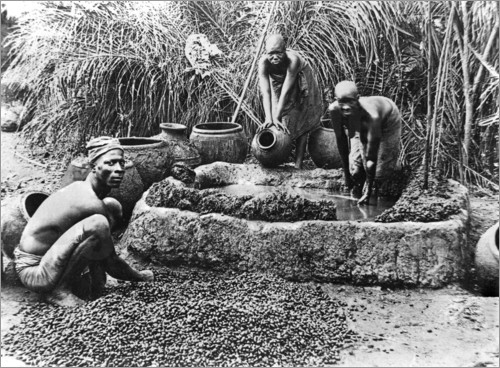 Bending & checking the Palm Kernel early 19th century at Dahomey
*** Dahomey was an African kingdom in the present-day Republic of Benin
which lasted from 1600 until 1900. Dahomey developed on the Abomey
Plateau in the early 1600s and became a regional power in the 1700s by
conquering key cities on the Atlantic coast. For much of the 18th and
19th centuries, the Kingdom of Dahomey was a key regional state,
eventually ending tributary status to the Oyo empire and being a major location for the Atlantic slave trade, possibly supplying up to 20% of the slaves to Europe and the Americas. In 1894, the kingdom became part of French West Africa as part of the territory of French Dahomey (which also included Porto-Novo and a large area to the north of Dahomey). French rule lasted until 1960 when the independent country took the name Republic of Dahomey, to be changed to Benin in 1975.
Feb 22, 2013

Feb 16, 2013
Red Palm Oil - Soap Making Oil and More!

Red Palm Oil, African Oil Palm, is cold pressed from the fruit of
the Elais Guineensis palm tree. It should not be confused with Palm
Kernel Oil, which is pressed from the seeds, instead. This palm tree can
grow up to 65 feet, with leaves, dense clusters of flowers and large
bunches of dark, orange-reddish, colored fruit. Each fruit is the size
of a large plum with a fleshy outer layer and a seed, (palm kernel),
inside. This tree flourishes in humid tropical weather and is native to
west tropical Africa.
Red
Palm Oil has numerous healthful benefits! It is a powerhouse of
nutrition! It contains more nutrients than any other dietary oil. Its
dark red vibrant color comes from carotenes such as: alpha-carotene,
beta-carotene and lycopene. These nutrients are the ones that give
carrots, tomatoes and other fruits and vegetables their rich colors. In
addition it contains, at least, ten other carotenes, vitamin K benefits,
CoQ10, squalene, phytosterois, flavonoids, pheolic acids and
glycolipids. It's rich with the benefits of vitamins A and E! For
example, it contains fifteen times more pro-vitamin A carotenes than
carrots and three hundred times more than tomatoes! This oil is one of
the richest sources of natural vitamin E! It contains natural
antioxidants benefits too!
This oil is different, somewhat, from
regular Palm Oil. It's not refined and bleached. It contains more
carotenoids, tocophenols and tocotrienols, with non-hydrogenated natural
saturated fats, (50%), and unsaturated fats, (50%). The main type of
unsaturated fat in Red Palm Oil is oleic acid, which is predominant in
Olive Oil, as well. Virgin Red Palm Oil is unrefined. It's 100% pure and
natural. This virgin oil has no coloring or additives. It retains a
high rich content of vitamins A and E! It has the fragrance of violets
with an earthy scent. It taste similar to olive oil. It's used a variety
of ways: to eat in foods, for cooking, for cosmetics or for making
homemade soap!
HEALTH BENEFITS:
It can be blended into
mayonnaise, salad oil or other foods. A tablespoon of Red Palm Oil is a
recommended dose when used for a dietary supplement. It can improve
blood circulation and protect against heart disease.
SKIN CARE BENEFITS:
Red
Palm Oil offers multiple skin care benefits! It has moisturizing and
healing properties. It's beneficial for eczema, dermatitis, psoriasis,
dry, sun damaged or premature aged skin. This oil is handcrafted into
many commercial and homemade skin care products. The vitamin E benefits
and vitamin A benefits make this oil a popular skin care choice!
MAKING HOMEMADE SOAP:
As
a soap making oil, it produces a nice hard bar of soap with a stable
lather. It blends well with other soap making oils, such as: coconut and
olive oil. In your homemade soap recipes you may want to naturally
color your soap a warm yellow-orange tint. You can achieve this by
adding a small amount of it to your base oils or superfatting at trace.
This oil has a shelf life of, approximately, eighteen months. Store it
in a cool, dry and dark location. Its level of saturated fat will help
resist rancidity.
Subscribe to:
Posts (Atom)